
CT3D: democratizing local product development and additive manufacturing
New Britain, CT company pushes the envelope of computer-aided design and manufacturing
FORGE supply chain member CT3D is a match for many physical product innovators in our network. The product design, manufacturing, and fabrication company based in New Britain, CT designs manufacturing processes in parallel with the products themselves. Its additive fabrication methods mean its clients – often makers, solo entrepreneurs and startups – can quickly and affordably iterate on prototypes and adjust production from single units to large-scale manufacturing.
We interviewed CT3D founder and owner Joshua Hinman to learn more about how his business supports local manufacturing and innovation, as well as how connections from FORGE have helped CT3D grow.
From napkin sketch to scaled production, CT3D enables everyone to innovate
Hinman was enrolled in Asnuntuck Community College’s advanced manufacturing machine technology program when COVID-19 spread to the U.S., cutting off his in-person studies and access to a machine shop. To keep studying at home, Hinman turned to computer-aided design (CAD) and 3D modeling. His first completed digital design was a brass watch case, which he turned into a physical object using MakerspaceCT’s CNC machine.
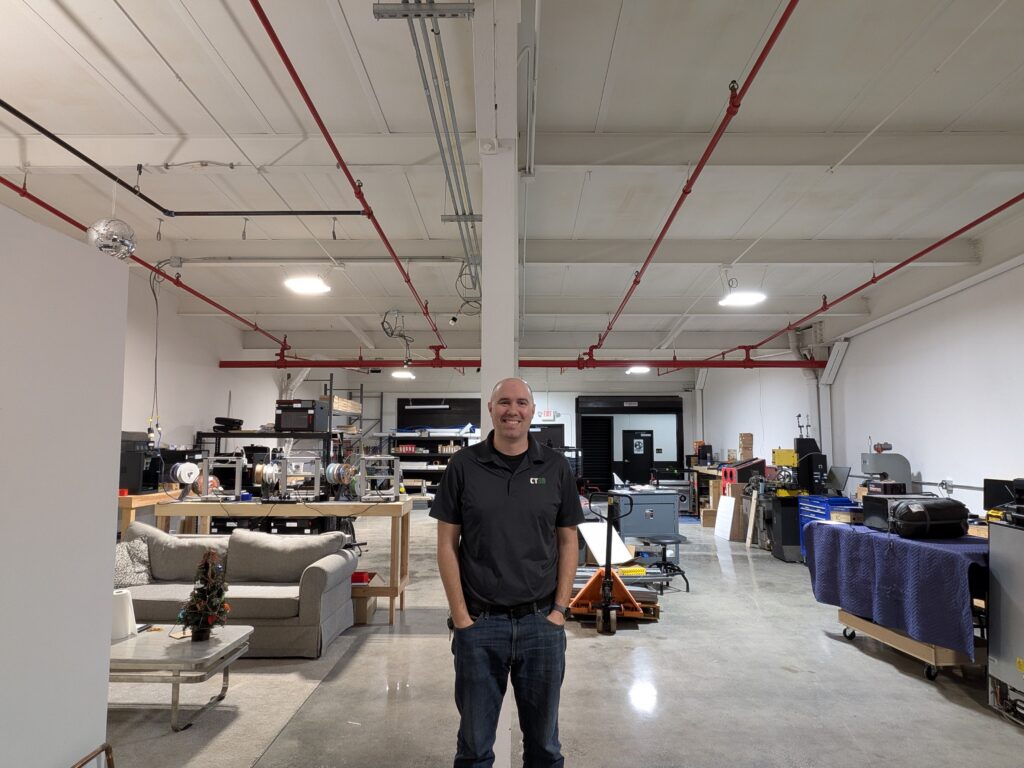
In 2022, Hinman graduated and started working as an aerospace CNC machinist. At the same time, he had mastered so many tools and techniques at MakerspaceCT that people were recommending him for fabrication jobs. Hinman created CT3D to turn those jobs into a business. The next year he had to rent his own shop in New Britain to keep up with orders. In November 2025, he expanded to a 2,000 sq. ft. shop in the same city.
“I started CT3D because I wanted to democratize access to product development,” Hinman said. “If you have an idea for a physical product, whether you’re an engineer, a homemaker, or teacher, you should be able to bring it from a napkin sketch to a finished product.”
To support innovators, CT3D uses a hybrid manufacturing approach, simultaneously designing a product and its manufacturing process. This ensures CT3D’s designs are practical to manufacture and fast to bring to market. CT3D’s additive manufacturing is also flexible; customers can incorporate user feedback without needing expensive new tooling, and use a “print on demand” model instead of storing inventory in a warehouse. If a product takes off, CT3D can easily transfer manufacturing to mass production with an on-demand manufacturing partner.
FORGE’s impact
Hinman first got in touch with FORGE as an emerging physical product entrepreneur, reaching out to display the watches he designs and manufactures at a FORGE showcase event. When the FORGE team learned about CT3D’s manufacturing capabilities, they started referring other innovators to Hinman.
Hinman said, “I’m glad FORGE is such an awesome cheerleader for manufacturing in the Northeast. People think America doesn’t make anything anymore, but we do. In Connecticut, you can get nearly any kind of manufacturing you want.”
FORGE has connected CT3D with a variety of local innovative companies. CT3D has worked with about a dozen, including:
- RBH Designs. Co-founder Ryan Hannigan consulted with CT3D about potential design and manufacturing strategies for a new invention (ergonomic work aid) for the technical sewing industry.
- ST Dispenser. ST Dispenser founder Jeremiah Brunson’s FORGE connection to CT3D led to a three-month development to design and fabricate a portable looks-like, acts-like prototype of a device that could recycle solid soap scraps into liquid hand soap. Hinman brought in a third-party computer programmer and graphic designer to contribute to the prototype’s electronics and visual design. Brunson is using CT3D’s 3D render of the device and the prototype to raise money from investors and demonstrate to prospective customers.
Not satisfied just to receive introductions from FORGE, Hinman makes introductions right back. He says he encourages his non-FORGE clients to join the FORGE community and apply for FORGE Product Development Grants.
“Whenever I see a FORGE connection email, I’m quick to answer them,” Hinman said. “I always try to make a connection.”
Looking forward – the future of domestic additive manufacturing
At the end of 2025, CT3D expanded into its new 2,000 sq. ft. shop. With more than double the floor space, the company had room to boost its large-format 3D printing capabilities with a Modix BIG60 3D printer and two additional BIG60 printers, giving it the largest Modix print-as-a-service fleet in Connecticut. For CT3D, 2026 is going to be all about upgrading the company’s shop and industry certifications. These upgrades will let CT3D provide manufacturing process development and hybrid manufacturing to defense, aerospace and medical device customers.
Hinman said it’s rewarding to participate in the democratization of design and manufacturing. He said he sees the growth of additive manufacturing, computer-controlled manufacturing technology like laser cutting, CAD design software, and AI tools like image generators and ChatGPT as part of a trajectory toward enabling more people from all walks of life to create physical products.
“These technologies are lowering the barrier to entry,” Hinman said.
Are you a founder interested in working with manufacturing companies like CT3D, or a supply chain or manufacturing company looking for connections with innovative companies? Contact FORGE to get involved.